Palaise Des Nations, 1211 Geneva 10, Switzerland
JIMENA Submission to UN Comission of Inquiry Ignored
To: Ms. Navi Pillay, Chair of Commission of Inquiry
Independent International Commission of Inquiry on the Occupied Palestinian Territory Including, East Jerusalem, and Israel
June 13, 2022. In May, 2021, the United Nations Human Rights Council (UNHRC) created a Commission of Inquiry to investigate the root causes of the Israeli-Palestinian conflict. This ongoing, permanent commission will publish reports every June to the UNHRC in Geneva and every September to the UN General Assembly in New York. The Commission invited individuals, groups, and organizations to submit information and documentation relevant to its mandate. As such, JIMENA submitted hundreds of pages of personal testimonies of Jewish refugees from North Africa and the Middle East.
On June 7th, 2022, under the direction of Commission Chair Navi Pillay, the commission released its first report. Unsurprisingly, the testimonies of Jewish refugees from the Middle East and North Africa were completely ignored. We share the cover letter of JIMENA’s February submission, again urging the UN to “fully incorporate the histories of Jewish refugees as one facet among many others that can assist in developing a just and sustainable future for Jews, Palestinians, and all those who are owed justice, security, and safety in the Middle East.”
To Ms. Pillay:
On 27 May 2021, the UN Human Rights Council passed a resolution establishing a commission of inquiry into human rights violations in Israel and the occupied Palestinian territories. Included in the commission’s mandate was a call to investigate “all underlying root causes of recurrent tensions, instability and protraction of conflict, including systematic discrimination and repression based on national, ethnic, racial or religious identity.”
The Commission also requested submissions from interested individuals and organization to provide information and documentation helpful to understanding the “[u]underlying root causes of recurrent tensions, instability and protraction of conflict in and between the Occupied Palestinian Territory, including East Jerusalem, and Israel; as well as systematic discrimination and repression based on national, ethnic, racial or religious identity.”
Needless to say, the “underlying root causes” of the recurrent conflict and tension in Israel and the Palestinian territories are complex and multifaceted. Some go back centuries, to the to the institutionalized subjugation of Dhimmi Jews under Islam. That said, it is evident that the circumstances through which many Israeli citizens came to arrive in Israel—and the concurrent circumstances which compelled their departure from their former homes—are among the root causes of the ensuing decades of conflict and instability, and so require their share of attention and analysis as part of the Commission’s overall mandate.
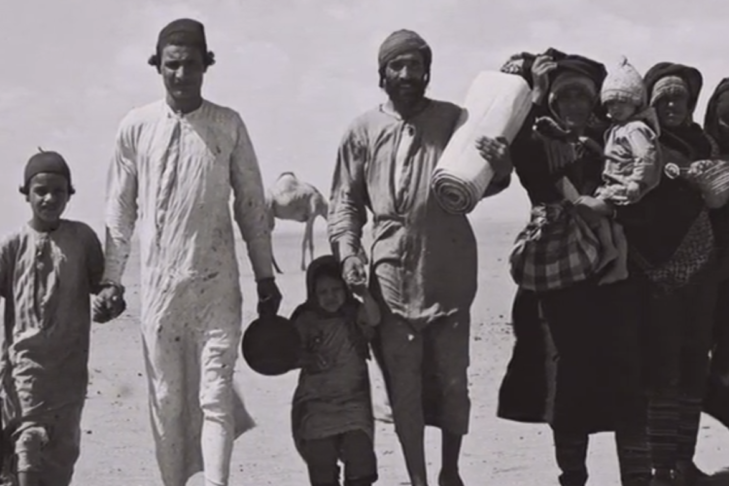
On behalf of JIMENA: Jews Indigenous to the Middle East and North Africa, we offer this submission documenting the experiences of the roughly 650,000 North African and Middle Eastern (Mizrahi and Sephardic) Jews who migrated to Israel in the years following its establishment. This migration which typically came in the wake of sustained and state-sanctioned discrimination and repression based on ethnic and religious identity emanating from other Middle Eastern states. Frequently, this discrimination was expressly tied to putative “anti- Zionist” commitments from these countries, and manifested in the form of violence, dispossession, denaturalization, harassment, and outright expulsion. It resulted in a massive and unprecedented ethnic cleansing of indigenous Jewish communities.
Jews thousands of miles from the conflict were thus subject to collective punishment and became hostages to the Arab-Israeli conflict. Discriminatory laws stripped Jews of their citizenship, excluded them from jobs, denied them trading licenses, froze their bank accounts, extorted money and sequestered their property without compensation. They were expelled or forced to flee.
Before it succumbed to pressure from the Palestinian leadership and declared war on the fledgling state of Israel in May 1948, the Arab League drafted anti-Jewish laws scapegoating their member states’ Jewish citizens as the ‘Jewish minority of Palestine’, although they were non-combatants. Zionism became a crime: Jews could be arrested, jailed and even executed on the flimsiest of pretexts: sending signals from their wrist-watches, possessing ‘Zionist’ symbols on a prayer shawl, etc.
This information is relevant as one piece in a much larger puzzle that can help explain the seeming intractability of the conflict in a fashion that does justice to the rights and experiences of all stakeholders. For example, when Middle Eastern Jews faced denaturalization and statelessness by nations putatively acting on “anti-Zionist” principles—as occurred in Egypt, Libya, and Iraq,—these practices of dispossession presented even indigenous Jewish Middle Easterners as a foreign element whose history and presence in the Middle East was illegitimate and warranted extirpation. When such Jews today encounter narratives which again present their presence in the Middle East as “colonial” or a “European” intervention, they hear more than the denial of the historical fact of their continuous presence in the region, they also hear an alarming echo of the same narratives which only a few decades ago warranted their expulsion from their homes. In part—not in entirety, but in part—the situation Israelis and Palestinians find themselves in today is caused by the blunt reality that much of Israel’s Jewish population is in Israel as a direct consequence of patterns of state-sponsored repression undertaken under the banner of and putatively justified by “anti-Zionism.” Many of these Jews accordingly believe, with ample historical evidence backing them up, that Israel’s existence as a Jewish homeland is indispensable to their safety and self-determination as a community. No account of the “underlying root causes” of the conflict in Israel and the Palestinian territories can succeed unless it reckons with this history in a clear-eyed fashion.
Currently, the Israeli Jewish population is approximately 50.2 Mizrahi and Sephardic in origin. Despite this, it has been an unfortunate feature of many prior inquiries and investigations into the Israeli-Palestinian conflict that the particular issue of Middle Eastern Jewish history has typically been ignored even by investigators possessing the best of intentions. This oversight has had troubling consequences. Most obviously, by omitting an essential facet of relevant regional history, the failure to reckon with the experiences of Middle Eastern Jews both distorts understandings of Israeli Jewish experience (often portrayed as primarily or even solely European in character) and hamstrings potential avenues for reform and progress, insofar as the resultant proposals typically fail to address crucial points of concern or redress essential to the Middle Eastern Jewish population. In addition, the omission of the immediate and directly relevant history of a large slice of the Israeli population in discussions about their lives and future serves to discredit the underlying work among persons who are critical stakeholders and essential participants in any future project to bring a just and enduring conclusion to the conflict. Consequently, JIMENA is pleased that the current commission’s mandate, insofar as it extends to all “underlying root causes” of the conflict, clearly encompasses a robust and comprehensive exploration of how the treatment of contemporary Middle Eastern Jewish history has been one significant contributor to continued conflict and tension.
It is, of course, impossible to roll back history. Justice in Israel and in the Palestinian Territories ultimately is a matter of moving forward to a just future, not attempting to revert to an imagined idyllic past. In these circumstances, history must be dealt with carefully. It is very easy to tell historical accounts which do not assist in overcoming calcified patterns of mistrust, but instead seem to warrant them and even encourage greater intransigence. There are no doubt many who look upon recent history—whether the history is that of Middle Eastern Jews, Palestinian refugees, Arab-Israeli wars, or any other frame—and claim it as buttressing their dim and cynical assessments of the vitality of any foreseeable resolution to the enduring conflict; or worse, vindicating their own demands for absolute and uncompromising political or territorial maximalism that is defiantly dismissive of the real and legitimate rights and prerogatives of their presumed adversaries.
But this is not the only way history can be used. History matters for understanding how we reached where we are today, and it matters for understanding how the people in Israel, the Palestinian territories, and around the world will process and react to emergent proposals aimed at securing justice, co-existence, and equality for all persons. Recent developments, such as the Abraham Accords, offer unprecedented opportunities to begin what will no doubt be an arduous but also necessary process of reconciliation between Middle Eastern Jewish communities and the states in which they formerly made their homes. Such steps are already beginning, and offer a model for how seemingly implacable adversaries can use history to overcome history. Our hope is that the Commission will not replicate mistakes of the past by relegating the experiences of Middle Eastern Jews to footnotes and asides, but will fully incorporate them as one facet among many others that can assist in developing a just and sustainable future for Jews, Palestinians, and all those who are owed justice, security, and safety in the Middle East.
Sincerely,
Board and Staff of JIMENA: Jews Indigenous to the Middle East and North Africa
cc. Mr. Miloon Kothari, Mr. Chris Sidoti
Tags
- Refugee Rights
- United Nations
- Antisemitism
- Advocacy
- JIMENA's Initiatives
- Jewish refugees
More Statements
Jewish Communal Request to Californa Governor to Adopt IHRA
To 40th Governor of California, Gavin Christopher Newsom. Jewish communities throughout our state are deeply affected during these challenging times of conflict and tragedy in Israel, and your unwavering support is pivotal for our collective sense of safety and wellbeing.
Endurance and Unity: Upholding Our Heritage in the Face of Continuing Threats
Dear Friends and Members of the Jimena Community, As Mizrahi and Sephardi Jews, we are all too familiar with attempts to erase our existence– from the Inquisition, to dhimmitude (the second-class status Jews held under Islamic rule for hundreds of years), to the mass expulsions of our communities in the mid-20th century– our history has, unfortunately, been colored by antisemitic threats and violence as an ethnic minority of the Middle East and North Africa. These efforts to erase our existence continue as we continue to bear witness to nearly daily direct attacks on Israel. As we watch the Islamic Republic of Iran and their proxies launch hundreds of rockets and drones, we understand these events are not isolated, but a continuation of the threat to Jewish life in the Middle East. Israel symbolizes not only the preservation of our rich and cherished history but also the triumph of reclaiming indigenous land. It stands as a beacon of strength and hope for all indigenous peoples of the MENA region who have faced subjugation and oppression under imperialism. We extend our hand in solidarity with the people of Iran, who know all too well the terror imposed by the Islamic Republic regime occupying their land. We understand that the regime’s actions do not reflect their own aspirations for freedom, liberty, and peace. This conflict is with the Islamic Republic, not the Iranian people, and we look forward to the day when they, along with us and the entire Middle East, are liberated from the regime’s despotism and chaos. In the face of threats by tyrannical rulers today, we stand steadfast in our identity as Jews, as Jews whose diasporic experience heralds from the Middle East and North Africa, and as Jews who support the existence of Jewish life in our ancestral homeland. Just as before, we will triumph over those who wish to destroy us, and we will continue to advocate for peaceful coexistence for all peoples in the region, so we may live our lives free from persecution, antisemitism, and hate. The People of Israel Live, today, tomorrow, and forever. Am Israel Chai. -The JIMENA team.
A Brief Guide to IHRA Definition of Antisemitism
An Introduction of the International Holocaust Remembrance Alliance Definition of Antisemitism