JIMENA responds to The Nakba Museum Project
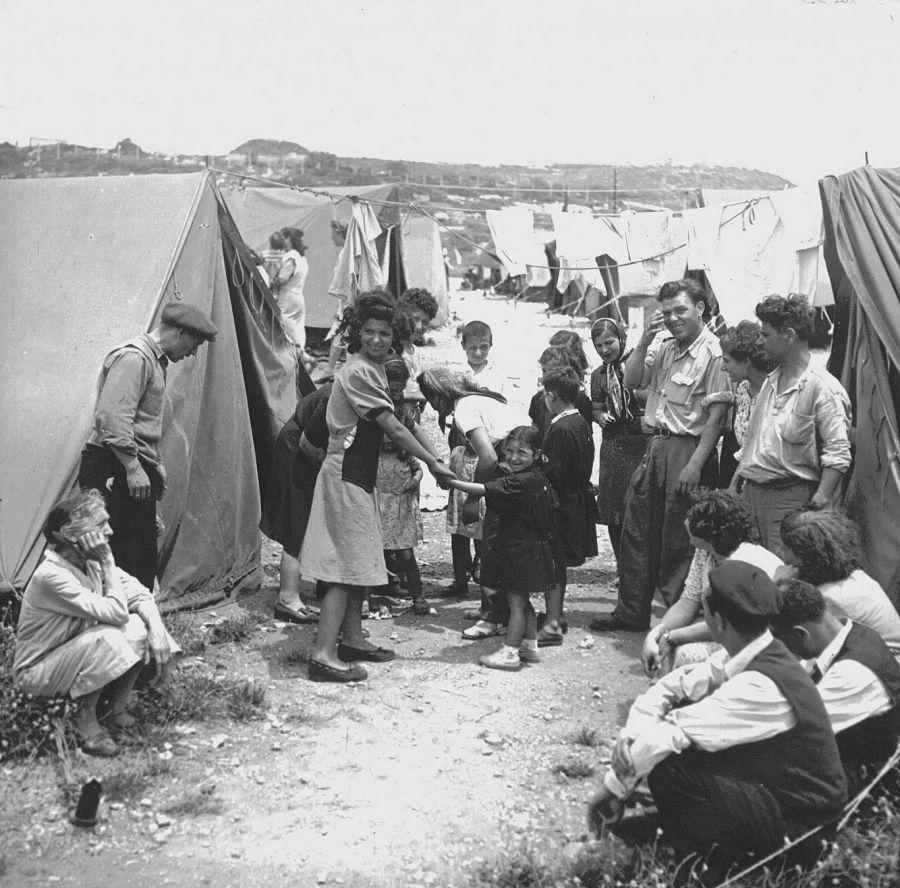
Displaced Mizrahi Jews from Arab countries in a temporary Israeli refugee camp known as Ma’barot
On June 13, 2015, “The Nakba Museum Project of Memory and Hope” plans to open their first exhibit, “Reclaiming the Lost Future,” in the Festival Center of downtown Washington D.C. Their ultimate goal is to build a museum that is dedicated to sharing Palestinian experiences of the “Nakba” – the Arabic word for “catastrophe,” used to describe Palestinian displacement following the establishment of the State of Israel.
As North America’s primary organization representing and preserving the experiences of Jewish refugees from North Africa and the Middle East, JIMENA supports the empowerment of all refugee voices. But we are concerned that The Nakba Museum will fail to raise awareness about the true perpetrators of the Palestinians’ ongoing victimhood and catastrophe: Arab League nations who, as a political weapon in their ongoing battle against Israel, deliberately refuse to resettle and absorb Palestinian refugees; and the United Nations Relief and Works Agency (UNRWA), who perpetrates the Palestinians’ never-ending refugee status. We are also concerned by the silencing of this conflict’s forgotten refugees: the nearly one million Mizrahi Jews expelled from their country’s of origin in the Middle East & North Africa in the 20th century.
JIMENA aims to shed light onto the untold story of the “Jewish Nakba.” An estimated 850,000 Mizrahi and Sephardic Jews were forcibly displaced from Arab countries as a backlash of the 1948 Arab-Israeli War. Their government-sanctioned persecution, murder, torture, imprisonment, and forced surrender of their homes, assets and nationalities was one of the most catastrophic events and immense losses in Jewish and Middle Eastern history. Yet this painful chapter of history is largely forgotten and ignored. There is no museum – and rarely even a single exhibit in any museum, Jewish or otherwise – dedicated to preserving and sharing the experiences of the 850,000 Mizrahi Jewish refugees.
The Nakba Museum believes that “sharing stories is a powerful tool to change perceptions, and to transform systems and conflicts.” While JIMENA may agree with this premise, we recognize that individual and collective Palestinian stories of displacement have long dominated Middle Eastern refugee narratives and discourse. The international community’s attuned attention, and in some cases obsession, with Palestinian suffering has not helped to positively influence the policies of UNRWA and Arab League nations. Instead, these entities continue violating Palestinian refugees’ rights by refusing to resettle and absorb them. For the sake of ending Palestinians’ suffering as stateless refugees in camps throughout the Middle East, we urge leadership of The Nakba Museum to avoid appropriating the Palestinian refugee experience for the purpose of singling out Israel. Rather than promoting unrealistic solutions to the Palestinian refugee problem, we hope they will responsibly use the opportunity of storytelling to critically examine the root problems and innovative, yet realistic solutions towards restoring Palestinians’ human rights and quality of life.
JIMENA continues to be concerned that the global obsession with the “Palestinian Nakba” has left a negligible gap of public awareness and attention towards the historical and current plight of millions of other displaced people in the Middle East including Syrians, Iraqis, and oppressed religious minority refugee groups such as Yezidis, Assyrians, Coptic Christians, and Jews. We believe that all refugee stories need to be acknowledged, and we remain committed to voicing the stories of Jewish refugees from Arab countries. We encourage well-established Jewish museums and educational institutions to join us by doing more to uphold and share the histories and cultures of Mizrahi refugees and their descendants.
For more information, we encourage you to read the following articles:
As the Nakba comes to Washington, a wasted opportunity
Ben Cohen, jns.org
May 7, 2015
What about the Jewish Nakba?
Ben-Dror Yemini, ynetnews.com
November 28, 2014
The Continuous Nakba: Two Arab refugees
Joe Samuels, Times of Israel
May 20, 2015
Their Nakba and our refugees
Dr. Edy Cohen, Israel Hayom
May 14, 2015
Iranian Jewish Refugees still not over forced exile from Iran
Karmel Melamed, Times of Israel
May 18, 2015
More Statements
Jewish Communal Request to Californa Governor to Adopt IHRA
To 40th Governor of California, Gavin Christopher Newsom. Jewish communities throughout our state are deeply affected during these challenging times of conflict and tragedy in Israel, and your unwavering support is pivotal for our collective sense of safety and wellbeing.
Endurance and Unity: Upholding Our Heritage in the Face of Continuing Threats
Dear Friends and Members of the Jimena Community, As Mizrahi and Sephardi Jews, we are all too familiar with attempts to erase our existence– from the Inquisition, to dhimmitude (the second-class status Jews held under Islamic rule for hundreds of years), to the mass expulsions of our communities in the mid-20th century– our history has, unfortunately, been colored by antisemitic threats and violence as an ethnic minority of the Middle East and North Africa. These efforts to erase our existence continue as we continue to bear witness to nearly daily direct attacks on Israel. As we watch the Islamic Republic of Iran and their proxies launch hundreds of rockets and drones, we understand these events are not isolated, but a continuation of the threat to Jewish life in the Middle East. Israel symbolizes not only the preservation of our rich and cherished history but also the triumph of reclaiming indigenous land. It stands as a beacon of strength and hope for all indigenous peoples of the MENA region who have faced subjugation and oppression under imperialism. We extend our hand in solidarity with the people of Iran, who know all too well the terror imposed by the Islamic Republic regime occupying their land. We understand that the regime’s actions do not reflect their own aspirations for freedom, liberty, and peace. This conflict is with the Islamic Republic, not the Iranian people, and we look forward to the day when they, along with us and the entire Middle East, are liberated from the regime’s despotism and chaos. In the face of threats by tyrannical rulers today, we stand steadfast in our identity as Jews, as Jews whose diasporic experience heralds from the Middle East and North Africa, and as Jews who support the existence of Jewish life in our ancestral homeland. Just as before, we will triumph over those who wish to destroy us, and we will continue to advocate for peaceful coexistence for all peoples in the region, so we may live our lives free from persecution, antisemitism, and hate. The People of Israel Live, today, tomorrow, and forever. Am Israel Chai. -The JIMENA team.
A Brief Guide to IHRA Definition of Antisemitism
An Introduction of the International Holocaust Remembrance Alliance Definition of Antisemitism