- WRITE the Main Questions on the board:
- What can we learn from the true personal stories of Jews from North Africa and the Middle East?
- How can we characterize the Jewish communities from these countries?
- ASK the students: What is history?
- The answer could be one-word, quick responses, or a paragraph response to a writing prompt.
- Have students share responses in a class discussion.
- Collectively note the similar responses and ideas about what defines history.
- ASK the students:
- How do we know what happened in the past?
- Who writes history? Present the students with one of the scenarios below:
- Personal History (for younger or older students):
- ASK students: “Do you know any stories about you when you were a baby?”
- INSTRUCT students to share that “baby story” with a student sitting next to them.
- SELECT a few volunteers to share their stories with the class.
- ASK students: “How do you know these stories actually happened? After all, you were not old enough to remember the events of the stories when they happened?”
- Help students arrive at the realization that someone else had to tell (transmit) those stories to them.
- Jewish Communal History (for older students)
READ AND DISCUSS Pirkei Avot (Ethics of the Fathers), which describes the Jewish commandment and connection to oral history and ethics. (Several websites can be easily found that provide commentaries for this chapter
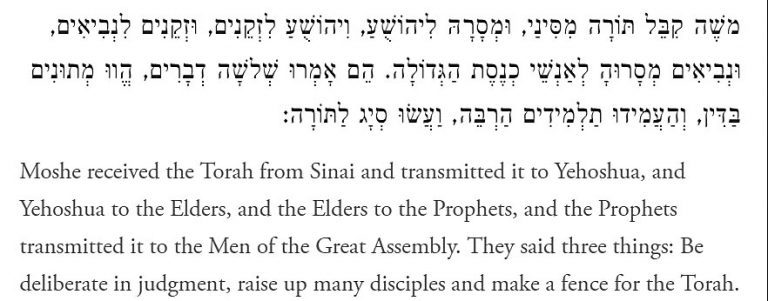
- DISCUSS with class:
- In what order was the Torah passed down from Sinai?
- What “advice” do the men of the Great Assembly give us for this important task?
- How were we given the Torah?
- How do we think we will pass it on?
How do we know what happened in the past?Who writes history?
C. EXPLAIN:
- a. Historians also collect stories about events, times, and places for which they may not have a personal memory.
- b. One method historians use to learn about history is interviewing people who experienced historical events.
- c. This process is called “oral history.”
- Personal History (for younger or older students):
Oral Histories

Middle School (Grades 6-8)
 Objectives
ObjectivesOral history is a collection and study of historical information about past events from the spoken stories of people who lived through them. JIMENA offers a collection of videos of Mizrahi Jews who share their stories from their countries of origin. In this lesson, students will have the opportunity to listen to the memories and perspectives of these people to better understand the experiences and histories of Jews from Middle Eastern and Arab countries. They will also gain an appreciation for the importance of preserving oral records for future generations.
Students will discuss their role or “link” in the chain of Jewish history.
- Students will listen to and report on oral histories from JIMENA’s Oral History Collection.
- Students will summarize and analyze the information presented in the interviews.
- Students will present the information in an acrostic poem to describe the key experiences of the interviewees.
 Materials
Materials- Computers/ laptops for students
- Projector
- Appendix A-Interview Questions
- Appendix B- Acrostic Poem worksheet
NOTE TO TEACHER
This lesson requires an internet connected device for viewing and hearing videos (tablets, iPads, laptops, computer stations with projectors or smart phones with a large enough screen for viewing and ample volume for interviews to be heard). You may also play the videos together as a class.
Listening to our Ancestors
- READ THE FOLLOWING OUT LOUD: “Today we are going to hear some stories told by Sephardic, North African and Middle Eastern Jews. Their stories are passed down using the same “technique” that Jews and other peoples have used for thousands of years. It is how we passed down the Torah and its laws from generation to generation- orally (or verbally). In Hebrew, this process is called “b’al peh” (בעל פה) which literally means “on the mouth.”Many Sephardic and Mizrachi Rabbis orally passed on commentaries, teachings, stories and parables. Legal decisions on issues of Jewish law and other important cultural and communal values were all transmitted orally and not recorded in writing until later in Jewish history.Your task, as historians is to:
- Carefully listen to the stories of these Jews who grew up in Middle Eastern and North African countries.
- Learn about how it was to live in these communities.
- Learn what languages Jews spoke.
- Explore how the Jewish communities interacted with the non-Jews around them and how they celebrated their Jewish lifecycle events.
- HAND OUT Appendix A
- EXPLAIN:
- Worksheet contains interview questions.
- While listening to the speakers, you will pretend you are historians interviewing these people.
- Students ANSWER QUESTIONS in Appendix A
- DIVIDE CLASS into 4 groups. Each group will listen to one of the JIMENA interviewees.
- STUDENTS VIEW the interviews, (interviews range from 5-8 minutes).
Gina Waldman (8 min) Born in Tripoli to a family that had lived in Libya for centuries, she was persecuted, nearly murdered and brutally expelled from her homeland in 1967, all because she is Jewish. As the hatred accelerated, a dozen years later, in 1967, Regina and her family fled to Italy, and she eventually immigrated to the United States, where for the past 35 years she has dedicated herself to the cause of freedom and the defense of human rights. Gina Waldman: Born in Libya, fled to Italy, immigrated to San Francisco
Mark Levy (6.5 min) Mark Levy was born in Alexandria, Egypt to a mixed family of Sephardic and Mizrahi Jews from Turkey, Iraq and Israel. In his testimony he recalls meeting his Iraqi grandmother for the first time in an Israeli camp for Jewish refugees from Arab countries as well as his memories of life and flight from Egypt. Mark Levy. Journeys of a Sephardic and Mizrahi Family
Margalit Oved (5.5 min) One of Israel’s most truly gifted choreographers and folklorists, Margalit Oved, talks about Jewish life in Aden, Yemen. Margalit helped hundreds of Yemenite children prepare for Aliyah. Margalit Oved, Jewish Life in Aden
Jacques Dahan (6 min) – Describes daily life in Morocco Jacques Dahan. Revisiting Jewish Life in Morocco’s Atlas Mountains. JIMENA Oral History, 2012