Personal Stories
Uncover the hidden narratives and vibrant legacy of the Jewish community. Explore the personal journeys shared below.
Written Narratives
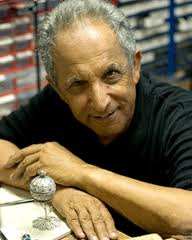
Yehuda Tassa
Yemenite Filigree: A Lost Art
By Janet Bein, Young at Heart Diva
www.tangodiva.com
Looking for jewelry that is exotic and artistic? Consider Yemenite filigree.
Its origins go back over 3000 years. Perhaps King Solomon’s romance with the Queen of Sheba was the reason that the Jews left Judea and arrived in Yemen by way of Africa. Once they arrived, they remained for centuries as the country’s primary artisans and craftsmen. The Muslims did not engage in this craft themselves. Some say that the Koran forbids Muslims from working with precious metals, and that the Koran considers it a blessing for a Muslim to buy jewelry made by someone of a different faith.
Yehuda Tassa, who has been living in Palo Alto, California for a good many years, began his apprenticeship in Yemenite filigree as a small boy in Israel. At the age of six, he started working on the simplest tasks under the direction of his father.
“For the first few years, all I did was twist and flatten the silver wires that are used to form the basic frame structures. Then I progressed to soldering.”
His father was a master craftsman and had been a renowned jeweler in his native Yemen before his aliya (immigration) to Israel. The techniques and secrets of Yemenite filigree and granulation were traditionally passed down from father to son, and not revealed to people outside the family. Granulation is a particularly challenging process where the tiny granules of silver are arranged in an intricate pattern and held together by a special formula adhesive.
Most of the Yemenite designs have a particular purpose and significance, such as a gift for the bride including symbols that promote fertility, wellness and prosperity. For example, the little balls represent fertility and the peanut shapes represent prosperity.
In his research of the history of Yemenite filigree jewelry, Yehuda came across another unusual design. It was a bracelet with a hemisphere and flower on one side, and a shape that looked like boxes or small houses on the other. Yehuda said, “The boxes were meant to represent a tomb and the significance was to remind the bride that we are not immortal.”
This sounds like an awfully sober message for a bride, but perhaps it would encourage the bride to appreciate her husband and disregard the day-to-day difficulties of life.
The most typical Yemenite filigree jewelry is made of silver, and Yehuda works primarily with this metal, often integrating it with precious or semi-precious stones. He creates earrings, necklaces and bracelets, based on the delicate and intricate designs from San`a, the capital of Yemen.
“San`a had 300 jewelry shops making filigree. The different shops specialized in different aspects—gold plating, fabrication, or granulation. Each shop had its own niche.”
Since San`a is the area that Yehuda’s family came from, he specializes in his family’s traditional San`a style. In addition to jewelry, he creates religious artifacts, such as Chanukah menorahs, mezuzah doorposts and spice boxes. Using his skills as a silversmith and lapidary, he also crafts some innovative designs for people who favor jewelry with a more modern look.
How did a Yemenite filigree specialist end up in Palo Alto?
“I didn’t come here as a jeweler, but as an aeronautical engineer.”
It was economics that motivated Yehuda’s unusual job transition. He grew up as a craftsman, creating Yemenite jewelry with his father and older brothers.
“My father died when I was nine. There were six children, three of them younger than I was. So I had to drop out after only one year of high school to help support the family.”
When he was 23 years old, he realized that making Yemenite filigree was not sufficient to support a family in the modern economy of Israel.
“I began studying on my own in evenings and eight months later passed the matriculation exams.”
Matriculation exams are the prerequisite to apply for institutions of higher education in Israel. Yehuda then went on to pass college entrance exams, and was accepted to the Technion Israel Institute of Technology (the Israeli equivalent of M.I.T). While working in the Israeli aircraft industry, Yehuda met a visiting American professor who invited him to come for a doctorate degree at Case Western Reserve. Yehuda accepted the invitation to come to the United States, completed his Ph.D., worked at NASA and then at Lockheed, spending 40 years as an aeronautical engineer. It was his work for Lockheed that brought him to California.
When he retired a few years ago, Yehuda took a lapidary class from Adult Education. For his final class project, he set a polished stone into a necklace of Yemenite filigree.
“Who did it?” the teacher asked him.
“I did,” answered Yehuda.
“It’s a lost art,” the teacher said, and asked to become Yehuda’s pupil.
Yehuda did some checking around and confirmed that the teacher was correct. Even in Israel, there were very few people left who knew the traditional methods of granulation and filigree. At one point, there had been someone who taught the art of Yemenite filigree at the Bezalel Academy of Art and Design in Jerusalem. But no longer. The older generation of Yemenite filigree craftsmen had died out.
So Yehuda returned to his original craft of making Yemenite filigree and now teaches the techniques of this ancient art form in various locations around the Bay Area, including the Mendocino Art Center (www.mendocinoartcenter.org), the California Institute of Jewelry Training (www.jewelrytraining.com), Beadissimo (www.beadissimo.com) in San Francisco, and the Little House (www.penvol.org) in Menlo Park.
In his spare time, Yehuda does Israeli folk dancing, long distance bike riding, and helps take care of his three grandchildren.
Timeline of Jewish Presence